Comparisons
Open Air vs Enclosed Photo Booth
Same camera, same attendant, different social contract. The curtain changes what guests are willing to do in front of it. Here is which one your room, your crowd and your Florida venue can actually take.
Short answer
An enclosed booth puts a curtain between your guests and the room, which is why the photos get sillier. An open air booth is a camera, a backdrop and an attendant, which is why it fits ten people and runs faster. Enclosed is $749 for 3 hours. Open air is $399 for 2.

Open air vs enclosed photo booth: the short answer
An enclosed booth is a structure with a curtain or a door. Guests go inside, the room cannot see them, and they behave accordingly. An open air booth is a camera on a stand pointed at a backdrop, with nothing between the guests and the party. Same camera quality, same attendant, completely different behavior in front of the lens.
Pick enclosed when you want privacy, prints and the classic look. Pick open air when you have big groups, a tight or awkward space, a crowd that will not queue for a curtain, or a budget that matters. Motion runs the enclosed option as the Classic at $749 for 3 hours and the open air option as the Social at $399 for 2 hours.
Everything below is the detail that makes that call for you rather than leaving it to preference.
What each one actually is
The enclosed booth
A freestanding structure with a screen inside, a bench or standing room, and a printer on board. Guests draw the curtain, take a sequence, and collect a printed strip on the way out. It occupies an 8 by 8 footprint, wants a 10 by 10 reserve, clears a 6 foot ceiling, needs one 110v outlet within 25 feet, and takes 45 minutes to set up. It handles 1 to 10 guests per photo and moves about 45 guests per hour.
The open air booth
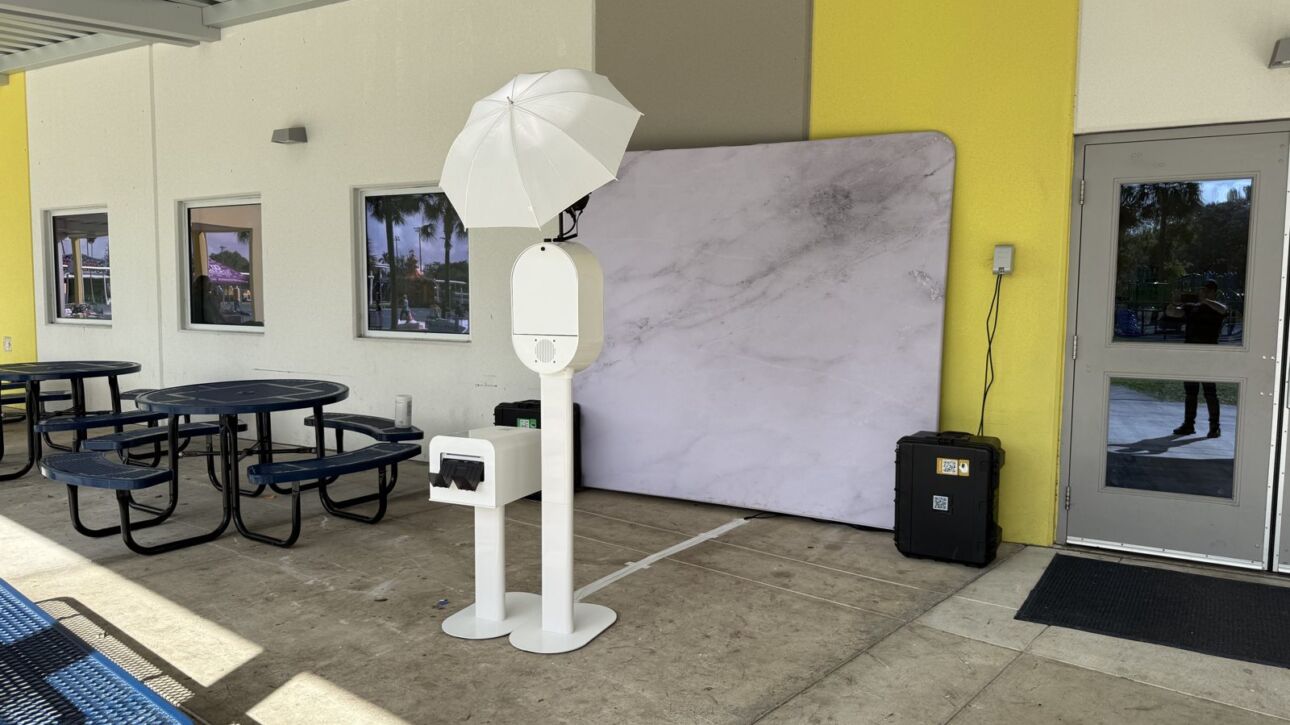
A camera and light on a stand, a backdrop behind the group, an attendant beside it. No walls. It wants the same 10 by 10 reserve and a 6 foot ceiling, runs off one standard wall outlet, and sets up in 30 minutes. Same 1 to 10 guests per photo, but it moves 50 to 60 guests per hour because there is no door to open, no bench to squeeze onto and no printer in the critical path.
Open air and enclosed photo booths compared
| Enclosed (Classic) | Open air (Social) | |
|---|---|---|
| Structure | Curtain or door, guests go inside | Camera, backdrop, no walls |
| Privacy | High, the room cannot see in | None, the booth is part of the party |
| Guests per photo | 1 to 10 | 1 to 10 |
| Throughput | About 45 guests per hour | 50 to 60 guests per hour |
| Footprint | 8 ft x 8 ft | Stand and backdrop |
| Space to reserve | 10 ft x 10 ft | 10 ft x 10 ft |
| Ceiling | 6 ft | 6 ft |
| Power | One 110v outlet within 25 ft | One standard wall outlet |
| Setup | 45 minutes | 30 minutes |
| Output | Prints plus digital | Digital first |
| Starting price | $749 for 3 hours | $399 for 2 hours |
The privacy argument for the enclosed booth
This is the real reason enclosed booths still exist, and it is not nostalgia. A curtain removes the audience. Guests who would never make a face in front of 120 people at a wedding will make that face when the only witness is four friends and a screen.
You can see it in the output. Enclosed booth galleries skew toward the photos people actually want: the ones where somebody is mid laugh, wearing a wig, sitting on a lap. Open air galleries skew toward posed group shots, because the room is watching and everybody knows it.
The privacy argument gets stronger with certain crowds. A corporate holiday party where people work together on Monday. A bar mitzvah where the adults want a turn but not an audience of teenagers. A wedding where half the guest list is your parents' friends. In all three cases the curtain raises participation from the people who would otherwise walk past.
The cost of that privacy is a slower line. A curtain is a door, and a door adds a few seconds of hesitation to every single turn. Over three hours that is the gap between 45 guests per hour and 50 to 60.
A curtain removes the audience. That is the whole product. Everything else about an enclosed booth is a consequence of it.
The group size argument for open air
Both formats are rated for 1 to 10 guests per photo, but those tens are not the same ten. Ten people inside an enclosed booth is ten people packed into an 8 by 8 structure, with the back row mostly heads. Ten people in front of an open air backdrop can spread out sideways and all be visible.
That matters more than it sounds, because the moments people want photographed are group moments. The bridal party. The whole table. The entire cousin contingent at a quinceanera. If your event runs on big groups, open air is the format that photographs them properly instead of compressing them.
Open air also fixes a problem enclosed booths have with a room: the booth becomes a box in the corner that people forget about. An open air setup reads as part of the party from across the floor. Guests see other guests using it, which is the mechanism that actually drives a photo booth line. You cannot see into a curtain.
One more practical point. An open air setup is easier for guests who use a wheelchair, a walker or a cane, because there is nothing to step into and no bench to negotiate. If your guest list includes people for whom that matters, it should weigh on this decision.
What your venue decides for you
Sometimes this is not a preference question at all. Before you weigh privacy against group size, check three things at the venue.
- Ceiling height. Both formats clear 6 feet, so this rarely disqualifies either one. Check anyway, because low hotel pre function areas and dropped ceilings near light fixtures come in tighter than people expect.
- The 10 by 10 reserve. Both need it. An enclosed booth occupies an 8 by 8 footprint of that, which means it is a solid object that cannot be tucked against a wall the way an open air setup can. If the only available space is a narrow strip along a wall, open air is your option.
- Power. Enclosed needs one 110v outlet within 25 feet. Open air needs one standard wall outlet. If the only spot that works is a terrace with no outlet nearby, that is a cable run and a conversation with the venue, and it is shorter for the open air setup.
Setup time is the fourth constraint and the one that catches people at hotel ballrooms with tight turnarounds. Enclosed takes 45 minutes, open air takes 30. Motion crews arrive 60 minutes before doors either way, but if your venue gives the vendor team a narrow load in window, tell us before you book rather than the week of.
One structural note about awkward rooms. An enclosed booth is a visual object. In a room with a strong design, it is either part of the look or it is a beige box in the photos. An open air setup disappears into the room and the backdrop does the visual work, which is why a custom printed backdrop at $250 tends to pair with open air more often than with enclosed.
Prints or digital: which format leans which way
The two formats are not locked to an output type, but they do lean. The enclosed Classic is built around a printer. Guests walk out holding a strip, and printing takes 10 to 12 seconds per photo. That is the format for a guest book station, a table favor, or anything that needs to exist on paper.
The open air Social is digital first. The output goes to a phone, which is where most of it was going to end up regardless. Nothing gets left face down on a table at the end of the night, and there is no print cap to worry about.
The honest note on printing: every copy is a turn extension. A group of six who each want a strip attaches roughly a minute of printing to one session. That is the mechanical reason the enclosed booth runs slower, and it is worth knowing before you assume prints are free. They cost time, not money.
Either way the images live in an online gallery that stays up for three years, so the digital copies exist whether or not anything printed.
What the gap actually buys
The Classic is $749 for 3 hours, which is about $250 an hour. The Social is $399 for 2 hours, which is just under $200 an hour. The $350 difference between the two packages buys you an enclosure, a printer and an extra hour. If nothing needs to be printed and privacy is not the point, that is $350 you do not have to spend.
Outdoors in South Florida: humidity, shade and wind
Every Motion booth can go outdoors with shade or a tent. Grass is acceptable but not preferred, because stands and structures want a level surface. That is the baseline. The South Florida specifics are where the two formats diverge.
Heat and humidity
An enclosed booth outdoors in July is a small room with no airflow. Guests will step in, take one look, and take the shortest possible sequence. Participation drops, and the photos get worse. An open air setup under a tent moves air and stays usable in conditions where a curtain becomes a sauna. For an outdoor daytime event in a South Florida summer, open air is the safer format by a wide margin.
Sun and shade
Shade is not optional for either format. Direct sun on a screen makes it unreadable, and direct sun on guests makes everybody squint. An enclosed booth carries its own shade for the guests but the electronics still want to be out of direct heat. An open air setup needs a tent or a genuinely shaded spot, and the direction matters, because shade at 4pm is not shade at 6pm.
Wind at waterfront venues
A backdrop is a sail. On a terrace on the Intracoastal or a beachfront deck, an unweighted open air backdrop is the first thing to go over. It gets weighted and an attendant stays with it, which is one more reason the attendant included on every booking is not a formality. An enclosed structure has more mass but also more surface area, so it is not automatically the safer outdoor choice on a windy night.
Practical rule: outdoors and in summer, lean open air under a tent. Indoors, air conditioned, with a guest list that wants prints, lean enclosed.
What each format costs at Motion
The Social open air booth is $399 for 2 hours. The Classic enclosed print booth is $749 for 3 hours. An extra hour on either is $150 to $250. A custom printed backdrop is $250, a full booth wrap is $250, and a guest book station is $150. Those are the numbers, published, with no form to fill out first.
Broward, Miami-Dade and Palm Beach carry no travel fee. Idle time is not a separate charge and counts toward your booked hours. An attendant is included on every booking, every job carries a backup camera and a backup printer, and the work is covered by a written guarantee.
If you tell us the venue, whether the booth is indoors or out, and whether anything needs to be printed, the choice usually makes itself. Read the full spec on the Classic enclosed booth and the Social open air booth, or see pricing for the whole lineup.
Common questions
What is the difference between an open air and an enclosed photobooth?
An enclosed booth is a structure with a curtain or door that guests step inside, so the room cannot see them. An open air booth is a camera pointed at a backdrop with no walls. Both take 1 to 10 guests. Enclosed gives privacy and prints. Open air fits big groups, sets up faster and runs faster.
What is a closed photo booth?
Closed, enclosed and traditional all describe the same thing: a booth with a curtain or door around it. Guests go in, take a sequence privately, and usually collect a printed strip on the way out. It occupies an 8 by 8 footprint, needs a 10 by 10 reserve and takes 45 minutes to set up.
Which is better for a wedding, open air or enclosed?
Enclosed if you want prints for a guest book and a crowd that loosens up behind a curtain. Open air if your event runs on big group photos, if the space is tight or oddly shaped, or if any part of the reception is outdoors in the heat. Plenty of weddings are better served by open air and nobody misses the curtain.
Can an enclosed photo booth be set up outside?
Yes with shade or a tent, and grass is acceptable but not preferred. Be realistic about South Florida heat though. An enclosed booth outdoors in summer has no airflow, and guests take the shortest possible sequence and leave. For a daytime outdoor event, an open air setup under a tent gets far more use.
How many people fit in an open air photo booth?
1 to 10 guests per photo, same rating as the enclosed booth. The difference is how those ten look. In front of an open air backdrop a group can spread sideways and everyone is visible. Inside an enclosed booth, ten people means a packed 8 by 8 structure and a back row of heads.
Does an open air photo booth print?
The open air Social booth is digital first, so the output goes straight to a phone. If printed strips are part of the plan, the enclosed Classic is the booth built around a printer, at 10 to 12 seconds per print. Every booth also loads to an online gallery that stays up for three years.
Do photo booths keep a copy of the photos?
At Motion, yes. Everything from the night goes into an online gallery hosted for three years, whether the booth printed or not. That matters more than people expect, because printed strips get left on tables and phones get replaced. The gallery is the copy that outlasts both.
Motion Event Productions
Every price on this page is on our pricing page
No form to see a number. No travel fee in Broward, Miami-Dade or Palm Beach. Idle time counts toward your booked hours instead of being billed on top. An attendant comes with every booking.
Keep reading