
Comparisons
360 Photo Booth vs Regular Photo Booth
The 360 and the regular booth are not two versions of the same product. One makes a video for a phone. The other makes a photo for a fridge. Here is the spec sheet and the honest downside.
Short answer
A 360 booth films a rotating video of up to 7 guests standing on a platform, with a 1,200 lb limit. A regular booth photographs 1 to 10 guests against a backdrop and can print. The 360 needs a clear 10 foot circle and a 7 foot ceiling. A regular booth needs 6 feet.
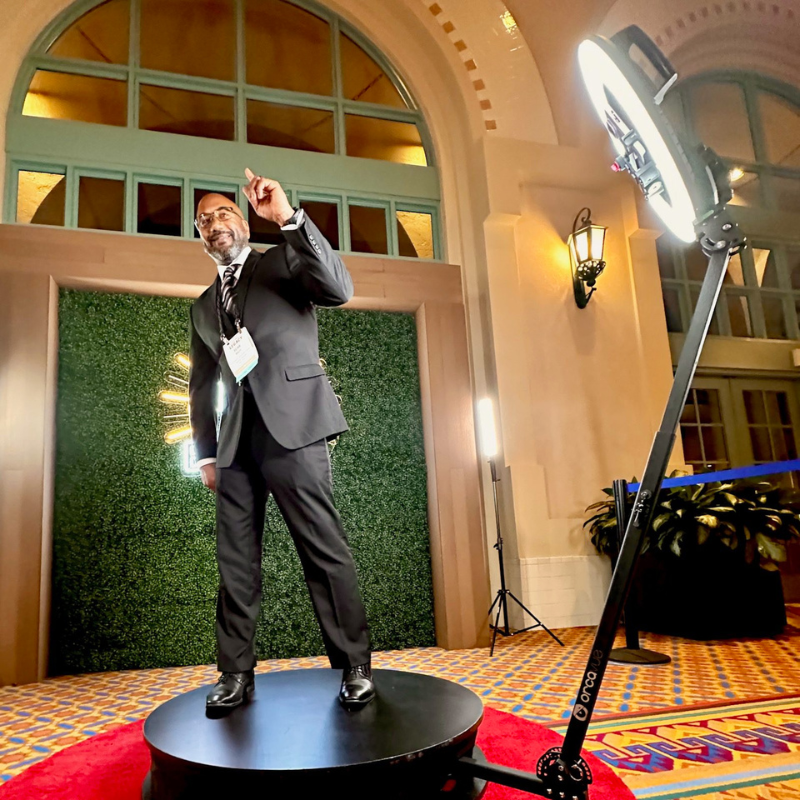
360 photo booth vs regular photo booth: the short answer
A 360 photo booth is a raised platform with a camera arm that swings around the people standing on it. The output is a short rotating video clip, usually slowed down, sent to a phone. A regular photo booth, which people also call a traditional or standard booth, photographs a group against a backdrop and produces a still image, printed or digital or both.
That difference drives everything else. The 360 needs a clear circle about 10 feet across and a 7 foot ceiling, because the arm travels. A regular booth needs a 10 by 10 area and clears a 6 foot ceiling. The 360 needs no power at all. A Classic print booth needs one 110v outlet within 25 feet.
Most comparison pages in this market stop at fun and interactive. The specs below are the part that decides whether the booth fits your room and your crowd.
What a 360 photo booth actually is
Guests step up onto a platform that sits a few inches off the floor. An arm holding a camera rotates around them while they move, and the software turns that pass into a short clip with slow motion, music and overlays. The clip goes out by text, email or AirDrop. There is no print.
The platform holds up to 7 guests with a 1,200 lb limit. Run the arithmetic on that limit before you picture a packed platform: 1,200 pounds across 7 adults is an average of about 171 pounds each. A group of seven grown men can reach the limit before they reach the head count. In practice the platform works best at three to five people, which is also where the video looks good, because seven people on a 10 foot platform crowd the frame.
Setup is 35 minutes. The arm needs its full swing path clear, so the reserve is not the platform footprint, it is the circle around it. If a cocktail table or a speaker stack sits inside that circle, the booth cannot run.
What a regular photo booth actually is
Regular, traditional and standard all point at the same category, and companies use the words interchangeably, which makes searching for a straight comparison harder than it should be. The category splits into two real formats.
The enclosed version is the one people picture: a structure with a curtain or door, a bench, and a printer. Motion runs this as the Classic. It takes 1 to 10 guests, occupies an 8 by 8 footprint inside a 10 by 10 reserve, clears a 6 foot ceiling, takes 45 minutes to set up, and prints in 10 to 12 seconds.
The open air version drops the enclosure. A camera on a stand, a backdrop behind the group, and an attendant beside it. Motion runs this as the Social. Same 1 to 10 guests, 30 minute setup, one standard wall outlet, and it is digital first. If the enclosure question is the one you are really asking, that is a separate decision from the 360 question and it deserves its own read.
Both regular formats produce a still image that can exist on paper. That is the functional gap the 360 cannot close. A video clip does not go in a guest book, does not go on a fridge, and cannot be handed to a grandparent at the table.
Side by side: the specs that decide it
360 booth compared with regular enclosed and open air booths
| Spec | 360 | Classic (enclosed) | Social (open air) |
|---|---|---|---|
| Output | Rotating video clip, digital only | Printed strips plus digital | Digital first |
| Footprint | Clear circle about 10 ft across | 8 ft x 8 ft | Compact stand and backdrop |
| Space to reserve | About a 10 ft circle | 10 ft x 10 ft | 10 ft x 10 ft |
| Ceiling height | 7 ft | 6 ft | 6 ft |
| Power | None needed | One 110v outlet within 25 ft | One standard wall outlet |
| Setup time | 35 minutes | 45 minutes | 30 minutes |
| Guests per turn | Up to 7, 1,200 lb limit | 1 to 10 | 1 to 10 |
| Throughput | About 40 guests per hour | 45 to 60 guests per hour | 45 to 60 guests per hour |
| Starting price | $699 for 3 hours | $749 for 3 hours | $399 for 2 hours |
Three lines in that table do more work than the rest. The ceiling, because 7 feet rules out rooms that a regular booth walks into without a second thought. The power, because a 360 can sit in the middle of a dance floor or out on a lawn with no cable run. And the weight limit, because it is the only spec here that has a hard safety answer.
The price gap is not the decision
The 360 is $699 for 3 hours. The Classic enclosed booth is $749 for 3 hours. Fifty dollars apart. Nobody should pick between these two on price. Pick on ceiling height, on whether your guests will step onto a platform, and on whether you want something printed.
Throughput: the 360 takes one turn at a time
A 360 booth moves about 40 guests per hour. That is the lowest figure in the lineup, and the reason is structural rather than technical. The platform holds one group. The arm has to finish its pass before anyone steps off. Then the clip has to process before it can be sent. None of those steps can overlap with the next group.
A regular booth has no such constraint on loading. Guests step in or stand up, the camera fires a sequence, and the next group is already moving into place. Over a three hour window the gap compounds into real coverage difference at a large event. Our guests per hour guide runs that arithmetic against a 150 person wedding if you want the full table.
None of that makes the 360 a bad choice. It makes it a feature booth rather than a coverage booth. If your goal is a clip that half the room posts that night, 40 per hour is plenty. If your goal is that every guest leaves with something, the number matters.
Who does not use a 360, and which events it is wrong for
This is the section the competing pages skip, and it is the one worth reading. The 360 has a real refusal rate, and it is predictable.
- Older guests. Many will not step up onto a raised platform, and no amount of encouragement from an attendant changes that. At a wedding with a lot of grandparents and parents, a meaningful share of the room will watch rather than participate.
- Guests with a cane, a walker, a knee, or anything else that makes a step up a decision rather than a reflex.
- Anyone in a long formal gown. Stepping onto a platform in a floor length dress and then moving for the camera is a hazard people correctly avoid.
- Guests holding a drink, which at a reception is most of them at any given moment. The drink has to go somewhere first, and that friction alone costs you turns.
- Anyone who wants something to hold. A 360 sends a file. It does not hand back paper.
Events where the 360 is the wrong booth
A room with a ceiling under 7 feet. This is not rare in South Florida. Hotel pre function areas, older banquet rooms and low tented setups regularly come in under that, and the arm needs the clearance. A regular booth clears 6 feet and fits where the 360 will not.
A guest book event. If part of the plan is guests pasting a strip into a book with a note beside it, the 360 cannot do it. That is a print booth job, and a guest book station runs $150 on top.
A conference or trade show where the point is a usable professional portrait or a branded printed takeaway. That is a headshot booth or a brand activation, not a 360. A rotating clip is not a LinkedIn photo.
An event where the crowd skews older across the board. A 50th anniversary, a corporate dinner for senior staff, a family reunion weighted toward the grandparents. The 360 is a teen and twenties magnet. That is a strength at a quinceanera and a liability at a retirement party.
How to pick using your room and your crowd
Work through it in this order and the answer usually falls out in two minutes.
- Measure the ceiling where the booth will live. Under 7 feet and the 360 is out. Ask the venue rather than eyeballing it, because dropped ceilings and light fixtures are the usual surprise.
- Find a clear circle about 10 feet across that is not on a traffic path. The arm swings, so the reserve is a circle, not a square in a corner.
- Look at your guest list age spread. If most of the room will step up onto a platform, the 360 earns its slot. If a third of the room will not, a regular booth reaches more of them.
- Decide whether anything needs to be printed. Guest book, table favor, something on the fridge. If yes, you need a print booth either as the main booth or alongside the 360.
- Check your window. About 40 guests per hour times your booked hours tells you how much of the room the 360 reaches.
Plenty of events run both, and that is often the honest answer at a quinceanera or a large wedding: a 360 as the thing people crowd around, and a print booth so the rest of the room leaves with something. Two formats cover two different crowds, and neither one has to pretend to be the other.
The 360 is a feature booth, not a coverage booth. Buy it for the clip people post that night, not to get the whole room photographed.
What each booth costs at Motion
The 360 Photo Booth is $699 for 3 hours. The Classic enclosed print booth is $749 for 3 hours. The Social open air booth is $399 for 2 hours. An extra hour on any of them is $150 to $250. A custom printed backdrop or a full booth wrap is $250, and a guest book station is $150.
Those numbers are on the site rather than behind a form. Broward, Miami-Dade and Palm Beach carry no travel fee. Idle time counts toward your booked hours instead of appearing as its own charge, an attendant comes with every booking, and the work carries a written guarantee.
If you know your ceiling height and your rough age spread, we can tell you in one reply which booth fits. Compare the 360 booth and the Classic booth side by side, or see full pricing for the whole lineup.
Common questions
What is the difference between a 360 photo booth and a regular photo booth?
A 360 films a rotating video of guests standing on a platform and sends it digitally. A regular booth photographs 1 to 10 guests against a backdrop and can print on the spot. The 360 needs a 7 foot ceiling and a clear 10 foot circle. A regular booth needs 6 feet and a 10 by 10 area.
What is the weight limit for a 360 photo booth?
Up to 7 guests and 1,200 lb on the platform. Worth doing the math: 1,200 pounds across 7 adults averages about 171 pounds each, so a group of seven adult men can hit the limit before the head count. Three to five people is where the platform runs best and where the video frames well.
How much space does a 360 photo booth need?
A clear circle about 10 feet across, plus a 7 foot ceiling. The reserve is a circle rather than a square because the camera arm travels all the way around. Nothing can sit inside that path, including cocktail tables, speaker stacks and cable runs. The 360 needs no power outlet at all.
Are 360 photo booths still popular?
Yes, and they draw a specific crowd. Teens and guests in their twenties line up for them. Older guests frequently will not step onto a raised platform, so at an event with a wide age range a 360 reaches less of the room than a regular booth does. Pick based on your guest list, not the trend.
When is a 360 photo booth not the right fit?
Rooms under a 7 foot ceiling, guest book events, conferences that need professional headshots or branded prints, and crowds that skew older. It is also the wrong pick when your goal is covering the whole room, since it moves about 40 guests per hour, the lowest of the lineup.
What is the best pose for a 360 photo booth?
Slow, wide movement beats fast movement. The clip is usually slowed down, so small quick gestures disappear and big ones read clearly. Raising a glass, spinning a jacket or a dress, confetti, and a group leaning in all work. Standing still and smiling makes a still photo with extra steps.
Can you have a 360 booth and a regular photo booth at the same event?
Often the right call at a large wedding or a quinceanera. The 360 draws a crowd and produces the clip people post that night. A print booth covers the guests who will not step onto a platform and gives everyone something to take home. Two formats reach two different halves of the room.
Motion Event Productions
Every price on this page is on our pricing page
No form to see a number. No travel fee in Broward, Miami-Dade or Palm Beach. Idle time counts toward your booked hours instead of being billed on top. An attendant comes with every booking.
Keep reading